

Blogs
G.communication in the Black
Mon, 06/01/2009 - 20:32 — ShawnAs a postscript to Sahashi's trial, I noticed this short blurb in the news:
「うさぎ」CMも再開 「NOVA」再拡大目指す
ワンマン社長と呼ばれた猿橋望被告(57)の手で国内最大手に成長したNOVAの経営破綻(はたん)から1年半。行き場を失った受講生の救済や外国人講師の雇用など、課題山積の事業を引き継いだジー・コミュニケーション(名古屋市)は、約半年で黒字化を達成。今年3月には、かつて人気を集めたマスコット「NOVAうさぎ」のテレビCMも再開した。
経営破綻後には、サウナや茶室付きの「豪華すぎる」社長室が公開され、企業のイメージは大きく傷ついた。社長室の机に飾られていた「NOVAうさぎ」のぬいぐるみが繰り返し報じられたこともあり、CMは長く封印された。
事業が軌道に乗り「効率化で完全復活した」(ジー社)と宣言するに至った新生NOVA。もはや猿橋被告とは無関係の別会社だが、「分かりやすいブランド名や『駅前留学』などのフレーズは大事に継承したい」と、事業拡大に意欲をみせている。
In short, g.communication has turned a profit largely due to the popularity of the new TV commercial (as far as I know, there's only one) and the NOVA bunny. despite the mountain of problems left by the collapse of NOVA, g.communication turned the business around in six months and started advertising again in March with the ever popular NOVA usagi.
Apparently there still is some value left in the NOVA brand and ekimae ryuugaku.
Sahashi on Trial
Mon, 06/01/2009 - 20:23 — ShawnSahashi's trial began today, and since as he was acting in the interests of the company.
The defense counsel for the founder of NOVA, the failed operator of an English-language school chain, asserted Monday that he was not guilty of embezzling funds from the employees' mutual assistance association, while the defendant admitted to diverting the money.
"There is no doubt about the facts," Nozomu Sahashi, 57, former president of NOVA, told his first hearing at the Osaka District Court on Monday. "I deeply apologize for causing great trouble to many students and employees. But, I didn't know I wasn't allowed to use the funds."
His defense counsel denied that his practice constituted embezzlement. "He diverted the money to refund tuition fees to students who canceled their contracts, and had no intention of gaining illegal profits. His actions don't constitute a crime."
Prosecutors will demand a penalty for Sahashi in their closing argument to be held on June 26 after questioning witnesses and the defendant.
I'm no lawyer, but the "I-didn't-know-it-was-illegal-but-took-the-money-anyway-because-it-was-in-the-interest-of-the-company" defense sounds pretty hackneyed to me. Then again, it should come as no surprise that this is Sahashi's angle. As we saw in magazine interviews after he was sacked, he's shown himself to be a very defiant and arrogant man.
Since there's not a whole lot of new information about the case that you don't already know, newspapers have taken the opportunity to refresh readers' memories. Nothing sells like reporting on the trial of an unrepentant president who screwed hundreds of thousands of people out of lesson fees and salaries. An article in the Kansai version of the Sankei shimbun tells the story of a 71-year old retiree who forked over 800 thousand yen for English lessons only to have NOVA go bankrupt shortly after he paid for his lessons. He can't go to the new NOVA because it's too far away, so he's given up on ever seeing a refund. He feels Sahashi owes students an explanation as to why NOVA went bankrupt.
The article also goes on to note other battles in the courts. A group of 27 students, mainly in the Kansai region, are suing the old NOVA's management and its auditors for approximately 21 million yen (roughly $221 thousand USD) in compensation. Lawyers for the students say it's regrettable that nobody has sought to hold NOVA's business practices criminally liable. He added that this civil case is one step toward finding the truth. This sounds like the lawsuit mentioned here last year where a group of 24 former students sued for 16 million yen, but the number of plaintiffs and amount of money sought don't match. Maybe more students have climbed on board?
- Shawn's blog
- or to post comments
Sahashi's Trial to Start June 1
Sun, 05/31/2009 - 11:35 — ShawnThe trial of former NOVA president Nozomu Sahashi is slated to start tomorrow, June 1, in the Osaka District Court. You'll recall that he was indicted last July on charges of embezzling ¥320 million from an employment benefit fund.
According to the Sankei shimbun, Sahashi will admit to raiding the fund, but as he has asserted in the past, his intent was not to embezzle the money but to scrape together enough operating capital to pay employees and save the company.
Original article
NOVA元社長、猿橋被告側が無罪主張へ 6月1日初公判
2009.5.30 23:44
経営破綻(はたん)した英会話学校「NOVA」の社員の積立金を横領したとして、業務上横領罪に問われた元社長、猿橋望被告(57)の初公判が1日、大阪地裁で開かれる。猿橋被告の弁護側は「業務上横領罪は成立しない」として無罪を主張する方針。
起訴状によると、猿橋被告はグループ社員の互助組織「社友会」の積立金を事業資金へ流用することを計画。平成19年7月20日、社友会の口座にあった3億2000万円を別の口座などを通じ、ノヴァ企画の口座に入金したとされる。
弁護人によると、公判では、猿橋被告が積立金を事業資金に流用した事実は認めたうえで、同時期に個人資産を提供し、社員給与約5億円や運転資金6億円以上を支払った事実を挙げ、「横領の意思はなかった」と訴えるという。
猿橋被告は、19年6月に中途解約時の受講料返還をめぐるトラブルで経産省から業務停止命令を受けた際に記者会見したが、その後は同年10月の会社更生法適用申請時や20年7月の保釈時も含め、一切公の場に出ず、口をつぐんでいる。
How to Have a Lousy Summer
Wed, 05/27/2009 - 21:24 — ShawnDrink happoshu:
More typical reactions included: "It's sort of out of focus" (Harrell on Tanrei); "It tastes like regular beer after 40 minutes" (Chujo on Tanrei); "Feels like I've just woken up and need to brush my teeth" (Chuwy on Reisei, a dai-san brewed from yellow-pea protein, 5 percent, ¥139); "It's like chewing paper. It's like they made beer but forgot to put the flavor in. If "Star Trek" made a machine that replicated beer but didn't quite get it right, it would taste like this" (Chuwy on Honnama, happoshu, 5.5 percent, ¥159). "Oooooh, that's not nice." (Kono on Style Free).
After a few rounds, the panel stopped commenting and switched to discussing why anyone would buy this crap.
I was reminded this article--and why I don't like happoshu-- after having a can of Tanrei foisted upon me at a party recently. As the article points out, happoshu and dai-san (third sector) "beer" came about in the 1990s as a way for brewers to skirt taxation. The brews have proven to be wildly popular, and their cheapness makes them all the more attractive during the current economic downturn. Who doesn't want to get drunk on the cheap? To that question, my reply is: Why would anyone buy this crap when you can have the real stuff instead? Regular Japanese beer is nothing to write home about, but it is at least drinkable. Moreover, why would you knowingly buy fake beer and then hope that it tastes like real beer? If your goal is to drink yourself silly, you're probably better off buying 4-liter jugs of Nikka Black or shochu.
Many of my Japanese friends drink happoshu because it's cheap, but every time I've had a can of the stuff I've wanted a chaser to get rid of the weird mouth feel and after taste. Why deprive yourself the pleasure of a good drink? Pinching pennies by drinking fake beer is only going to make you miserable.

If you really love beer, but lament the fact that microbrews are hard to find, take heart! The Great Japan Beer Festival is near and will be held on the following dates:
- June 6 & 7 at the Ebisu Garden Hall, Tokyo
- July 18, 19, and 20 at the Kyocera Dome Sky Hall, Osaka
- September 19, 20, and 21 at the Osanbashi Hall, Yokohama
I've gone the past few years and it's always a good time. There are over 100 microbrews to sample and they run the gamut. There's gimmicky:

Strange blue stuff:

And of course there's lots of good stuff:

Personally, nothing beats the heat like a cold wheat beer, and the Great Japan Beer Festival has plenty of them.
Tickets
Advanced tickets are ¥3800, and ¥4500 yen for same-day admission. Advanced tickets for the event in Tokyo cost ¥4300, and same-day admission is ¥4800. You can purchase tickets at most convenience stories or Ticket Pia outlets.
Would-Be Viagra Dealers Face Stiff Penalty
Mon, 05/25/2009 - 21:28 — ShawnSaw this on the Ch.6 evening news. Two men were caught trying to sell a Viagra-like product in violation of the Pharmaceutical Affairs Act. According to the report, the men are suspected to have sold a box of "Viasheets" in a vending machine in January. One box nearly six months ago? And this is news?
I didn't think much of the story until I saw pictures of the product:
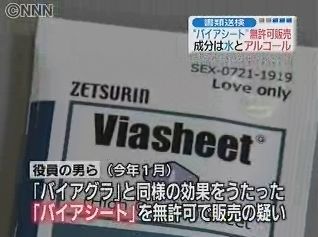

Whoever made the "drugs" had a sense of humor. The "Viasheets" were nothing more than water and alcohol.
- Shawn's blog
- Login or to post comments
Working for the New NOVA
Sun, 05/24/2009 - 10:42 — ShawnThe blog Tofugu has an interview with a current neo-NOVA employee. There's not a lot you haven't heard before, but it's still worth a read for its summary of the aftermath of NOVA's collapse and the perspective on what it's like working for NOVA now.
If you're thinking about working in Japan, the word on NOVA is simple: Don't bother working for them.
5. Would you recommend anyone coming to Japan to try and get a job at G. Education?
Honestly? At this point, no. Come to Japan and try to get a job, sure. But don’t try with G. Education… too much is up in the air at this point, the company hasn’t really figured out what the hell it’s doing and is still not turning a profit as of yet. We’re all still sort of holding our breath for the second grand finale, though that is by no means for sure what’s going to happen. The bottom line is that the future is uncertain, and the management is clueless. I shudder to imagine the mixups and lack of help someone brand-new to Japan would have, all on behalf of G. Education.
Best bet is to get a contract with one of the other big eikaiwas before setting foot in Japan, unless you’ve got a significant savings and don’t mind tightening your belt and not indulging in the tourist experience until your situation gets a bit stable. You can build a decent schedule that will support a comfortable lifestyle, including partying and touristy stuff, but it takes time and multiple small companies.
Amazingly, this teacher has fond memories of NOVA:
Old NOVA, while a typically evil corporation out to squeeze every bit of profit it could from its customers and its employees, was at least reasonably efficient and under control. When management told us something, we generally could feel it was reliable (up until the spiral into bankruptcy, anyways). It knew how to manage foreign employees and had a system set up that took care of all the little details that foreign instructors would have to deal with, moving to a foreign country. The new NOVA is lacking in reliability, know-how, awareness of the differences between foreign and Japanese management style / work expectations
So, old NOVA was evil, and the new NOVA is a mess, but as long as the paychecks keep coming in everything is OK. That's an awful justification. You have three choices when you work for an employer like this:
- Fight for your rights and take them to court if necessary
- Quit and find another job
- Give up on your life in Japan and return home
Sadly, it seems this particular teacher has chosen a fourth option: do nothing. G.communication and schools like it will continue to limp along for a long time so long as they have a steady supply of compliant teachers suckers. Don't be a sucker if you want to teach in Japan.
Eco Pointless
Wed, 05/13/2009 - 22:42 — ShawnHere we have to the 12,000 yen give-away:
The government will give up to 39,000 yen in "eco points" to buyers of eco-friendly home appliances under a new environmental program.
If you think you can use those points to purchase more stuff, just like you would if you were shopping at a major electronics retailer, you'd be mistaken.
Under the plan, buyers of environment-friendly appliances can earn "eco-points," and redeem the points for goods or gift certificates. For example, those who buy a 46-inch digital television set can receive 39,000-yen worth of eco-points, the highest figure available, according to a release by the government.
Buyers, however, have to wait until after June, after the supplementary budget bill for fiscal 2009 passes through the Diet, to find out how to apply for the points, and are likely to be able to redeem the points in July at the earliest. Since consumers were withholding from buying products as they waited for the program to come into effect, the government decided to start the point-earning period earlier than initially set.
Are you kidding me? I'm supposed to happily fork over hundreds of thousands of yen to purchase electronics in exchange for gift certificates? Plus, I have to wait to find out how to apply for the points and for what I can redeem them? They literally have not thought this plan through.
Like the 12,000 yen give-away, eco points aren't going to boost consumption, especially when Japan's manufacturers are posting record losses, people are losing their jobs, and the government publicly mulls raising the consumption tax.
Step up to the Urinal, Mr. President
Wed, 05/13/2009 - 21:01 — ShawnEngrish creeps up on you in the strangest places. A shot from the men's room:

While the Japanese is asking you to take an extra step forward so you don't dribble all over the floor, the Engrish remains a mystery.
- Shawn's blog
- Login or to post comments
Berlitz Drags its Feet
Tue, 04/28/2009 - 15:57 — ShawnWhen we last saw Berlitz, it was suing five of its instructors and two officials of the National Union of General Workers (NUGW) Tokyo Nambu for ¥110 million in damages each on the grounds that their strike was illegal and that the union was trying to damage the company.
A column in the Japan Times, however, notes that the court proceedings are going nowhere fast. Instead of pressing their case, Berlitz appears to have decided on a battle of attrition by waiting out its instructors.
Both sides appear prepared for a lengthy legal battle. After the first January court date for Berlitz's lawsuit, Ken Yoshida, one of the union's lawyers, said the company's legal team was "stalling," and that it would be a long, drawn-out court fight. So far, Yoshida's prediction seems to be proving accurate. Berlitz lawyers have been repeatedly late submitting the required documents for both their suit against striking teachers and the Labor Commission hearings. This leads to further delays because union lawyers don't have time to prepare a proper response.
According to Timothy Langley, a lawyer and president of Langley Enterprise K.K., a consultancy specializing in labor issues, such delays by company lawyers are "no big deal, the court is very lenient." He speculates that "it could be their litigation strategy."
"Who can survive this fight the longest? It isn't the employees," said Langley. "The company can survive this fight for a long time. It's one of the costs of doing business. The employees are doing it because it's their livelihood. It wears on the employees much more than on the company."
As the column notes, suing workers for an illegal strike is an attack on Article 28 of the Constitution, which guarantees the right to organize and to bargain and act collectively, and would have ramifications for industrial relations across Japan. Fortunately, the law is on the side of the instructors, and Berlitz's argument that the strike is illegal is very weak.
The second hearing in the suit lasted a matter of minutes. One judge complained that after reading the company's recently filed documents he still couldn't understand their reasoning for why the strike was illegal. He told Berlitz's lawyers to provide a concise and understandable summary of their arguments before the next hearing. Looking at the crowd of union supporters in the courtroom, the judge added that the summary was necessary not only to help him understand the company's position, but also for the benefit of all those coming to hear the case.
Campbell expressed disappointment at the latest delay. "It's the dragging-on that's very frustrating. They sued in December and you'd think they would have their evidence prepared. In this case they sued and then prepared their evidence. Not only that, but they took an enormous amount of time and still haven't finished it all."
Union rep Carlet added, "It's outrageous that the company has submitted almost nothing in terms of evidence that the strike is illegal. They haven't specified where the damages are coming from. All they did was sue, and they haven't come out with anything."
Since the article compares the case to "trench warfare," I expect there will a lot casualties once this battle is over. But this is something worth fighting for. If instructors don't stand up for their rights, they will forever be stomped on by their eikaiwa employers. That said, I wonder if Berlitz isn't shooting itself in the foot with this lawsuit. Berlitz claims that the instructors intended to harm the company, but when they decided to sue their own employees, they showed everyone for what they really are: a malicious, union-busting employer.
Revised Visa Renewal Procedures Starting in 2010
Mon, 04/27/2009 - 16:21 — ShawnAccording to the Ministry of Justice, effective April 1, 2010, you will have to show your health insurance card--either kenko kokumin hoken (National Health Insurance) or shakai hoken (Company Health Insurance)--when you apply to renew your visa or change your visa status. If you do not belong to one of these plans, you will be encouraged (forced?) to join or your visa could possibly be revoked.
How do you get coverage? You can apply for kenko kokumin hoken at your ward office; you can apply for shakai hoken through your employer.
It'll be interesting to see how the eikaiwas react to this. For decades, they have avoided enrolling their employees into the system by playing with the number of hours worked per week, a subject that was brought up here back in 2005..
Related links
- Employees’ Health Insurance from the Social Insurance Agency
- Public Social Welfare System FAQ from the General Union
LJ is currently using a spam filter, which may eat legitimate comments, particularly those containing URLs. If you are having trouble posting a comment, email LJ.

Recent comments
6 days 15 hours ago
6 days 17 hours ago
6 days 20 hours ago
6 days 20 hours ago
6 days 21 hours ago
6 days 21 hours ago
1 week 10 min ago
1 week 6 hours ago
1 week 8 hours ago
1 week 8 hours ago